

From 31 October, officers not councillors must decide householder and small housing applications in Bury. Ward call-ins and objection triggers will no longer force a committee hearing.
If you object to a neighbour’s extension in Bury and expect councillors to decide it, that stops on 31 October 2026. From that date, householder applications must be decided by council officers. No councillor can call one in, and no number of objections can force it to a committee.
The change is national, not local. It went before Bury Council’s Planning Control Committee for noting on Tuesday 1 September, in a report from the Head of Development Management which is blunt about how little say the council has: “The Council has no discretion as to whether or not to implement the National Scheme of Delegation.” The full agenda carries the report and the draft council report attached to it.
The full decision goes to Full Council on Wednesday 16 September.
What officers must now decide alone
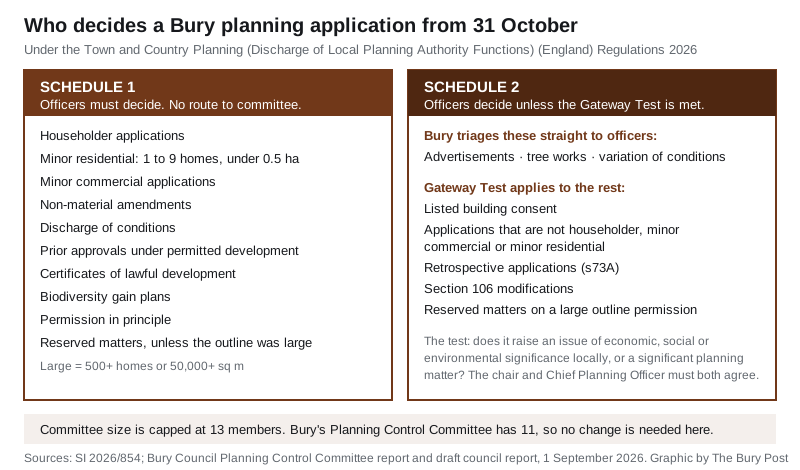
The rules come from the Town and Country Planning (Discharge of Local Planning Authority Functions) (England) Regulations 2026, made on 15 July 2026 and in force from 31 October. Schedule 1 of those regulations lists the applications that must go to officers and cannot be referred to committee at all. They include:
- householder applications, the category that covers most work within the grounds of a single home, extensions included
- minor residential applications
- minor commercial applications
- non-material amendments to a permission
- applications to discharge conditions
- prior approval applications under permitted development
- certificates of lawful development, existing and proposed
- biodiversity gain plans
- reserved matters on an outline permission, unless it is a large one
- permission in principle
The regulations define a minor residential application precisely: development that is only dwellings, of at least one but no more than nine of them, on a site smaller than 0.5 hectares. A nine-home scheme on a half-hectare plot is therefore an officer decision, by law, whatever the neighbours think of it.
The same regulations define a large outline permission as 500 or more dwellings, or 50,000 square metres or more of floorspace. Reserved matters below that threshold drop to officers too.
What can still reach the committee, and the test it must pass
Schedule 2 covers everything else, and the starting point there is also delegation to officers. An application only goes to committee if two named people agree it should: the Nominated Member, who at Bury will be the chair of the Planning Control Committee, and the Nominated Officer, who will be the Chief Planning Officer. The draft names the committee’s vice chair as the substitute member, marked “to be designated”, and the Head of Development Management, then the Team Leader for Development Management, as substitute officers.
They have to apply what the regulations call the Gateway Test. The draft report going to Full Council sets it out. The proposal must raise either:
- one or more issues of economic, social or environmental significance to the local area, or
- one or more significant planning matters, having regard to the development plan and any other material considerations
Bury is also using a local discretion the guidance allows. The draft report puts three categories of Schedule 2 application straight into the officer pile as “triaged”, so the gateway test is never reached for them: advertisements, tree works applications and variations of conditions. Nationally those sit in Schedule 2 and could in principle be referred; in Bury they will not be.
What is left in Schedule 2 and still subject to the test is where the contentious cases live:
- listed building consent, and applications to vary or discharge its conditions
- any planning application that is not householder, minor commercial or minor residential
- retrospective applications under section 73A
- modifications and discharges of section 106 obligations
- reserved matters on a large outline permission
The report is candid about where the bar now sits. Applications are “unlikely to raise a significant planning matter where they broadly comply with an allocated site and relevant planning policies”. Referral on local-importance grounds “should be limited to cases involving issues of notable local importance, such as major residential developments, the loss of key community facilities, or changes to significant listed buildings”.
The two routes that stop working
Two things Bury residents have relied on are being switched off, and the report says so directly.
- Ward councillor call-in. The committee report states that “Ward Member call-in arrangements and objection number triggers will not be able to override the National Scheme of Delegation.”
- Objection thresholds. A count of objections will no longer, on its own, send an application to committee.
There is also a ban on lobbying the two people who now hold the referral decision. The draft constitution wording says the Nominated Member and Nominated Officer “shall not be lobbied or otherwise contacted by any person or organisation, including by members or officers of the relevant authority, to use their power in a particular way”, and that any lobbying received must be reported to the Monitoring Officer.
One rule that does not bite in Bury
The regulations cap planning committees at 13 members. Bury’s Planning Control Committee currently has 11, so the cap requires no change here. Some councils will have to shrink; Bury will not.
Applications made by the council itself, by a councillor or by a senior officer are treated separately as “Own-Interest Applications”. Those may still be referred to committee for transparency even when the gateway test is not met, but if they are not referred, an officer decides them.
What it means for you
- If your neighbour applies for an extension after 31 October, you can still comment, and the officer must still consider your comments. What you cannot do is get it in front of councillors.
- If you are fighting a small housing scheme, check the numbers. Nine homes or fewer on under half a hectare is now, by law, an officer decision.
- Objecting in bulk no longer changes who decides. It may still change the outcome. It will not change the forum.
- Your ward councillor cannot call it in, and asking the committee chair to intervene is specifically prohibited as lobbying.
- For anything genuinely large or contentious, the committee route survives. Major residential schemes, the loss of a community facility and changes to significant listed buildings are the examples the council’s own report gives.
- The council has to rewrite its constitution before 31 October. The report warns that decisions taken after that date which do not follow the regulations “could be considered unlawful by a Court”. Full Council takes it on 16 September.
The government must review how the regulations have worked and publish that review by 31 October 2028.
We list Bury planning applications as they are validated each week on our planning applications page, with a link to each one on the council’s own register.
Have your say